A kayak is the simplest boat on the river and one of the easiest to paddle badly. A few adjustments to your setup and your stroke will have you covering twice the water with half the effort.
The Steinhatchee is a good place to learn. The river is calm, the current is manageable, and Deadman's Bay is only about a mile and a half downstream. But calm water still rewards good technique, especially when the wind picks up or you are paddling against an outgoing tide at the end of the day.
Set up the boat and your body
Most beginners lose power before they take a stroke. Sit up tall rather than slouched against the seat back, with your feet on the pegs and your knees slightly bent. Your legs should feel connected to the boat, not dangling. Adjust the seat so you are not reaching, and set the foot braces so your knees press lightly into the hull.
Hold the paddle with your hands a little wider than shoulder width, knuckles aligned with the blade edge. For a standard paddle, the concave side of the blade faces you. If the paddle has a feathered setting, keep both blades in line while you learn; it makes the stroke simpler.
The forward stroke
Power comes from your torso, not your arms. Reach forward and plant the blade near your toes, then rotate your body and pull the boat past the blade. The lower hand pushes, the upper hand guides, and the blade exits around your hip. Keep the stroke long and smooth, and let the blade come out cleanly rather than dragging it through the water.
- Common fix: if your arms burn after ten minutes, you are pulling with them. Rotate from the waist and think about pushing with the top hand.
- Common fix: if the boat wanders, you are probably taking short, choppy strokes on one side. Even out the rhythm and look at the horizon, not the bow.
- Common fix: if you are splashing, the blade is entering too flat. Plant it more vertically and keep it buried through the stroke.
Steering and stability
You steer with sweep strokes and stern rudders, not by switching sides every stroke. A sweep stroke is a wide arc on one side; a stern rudder plants the blade behind your hip and holds it there while the boat turns. For small corrections, edge the boat by shifting your weight slightly toward the turn.
Stability improves when you keep your head up and your hips loose. If the boat rocks, brace with a low, flat blade on the water and let the hull settle. Fighting the motion is what tips people over. Practice a wet exit in shallow water before you paddle deep, and know how to climb back in.
Plan the paddle around the tide
On the Steinhatchee, the tide and the wind decide how hard your day will be. Paddle upriver or into the wind first, then let the current or the breeze carry you home. Check the tide and weather before you launch, and give yourself more time than you think you need.
A good half-day route is upstream into one of the creeks, a slow drift back past the docks, and a loop out toward the bay if the wind allows. The grass flats in two to eight feet of water are worth the trip, but stay off them when the tide is low and the blades are close to the surface.
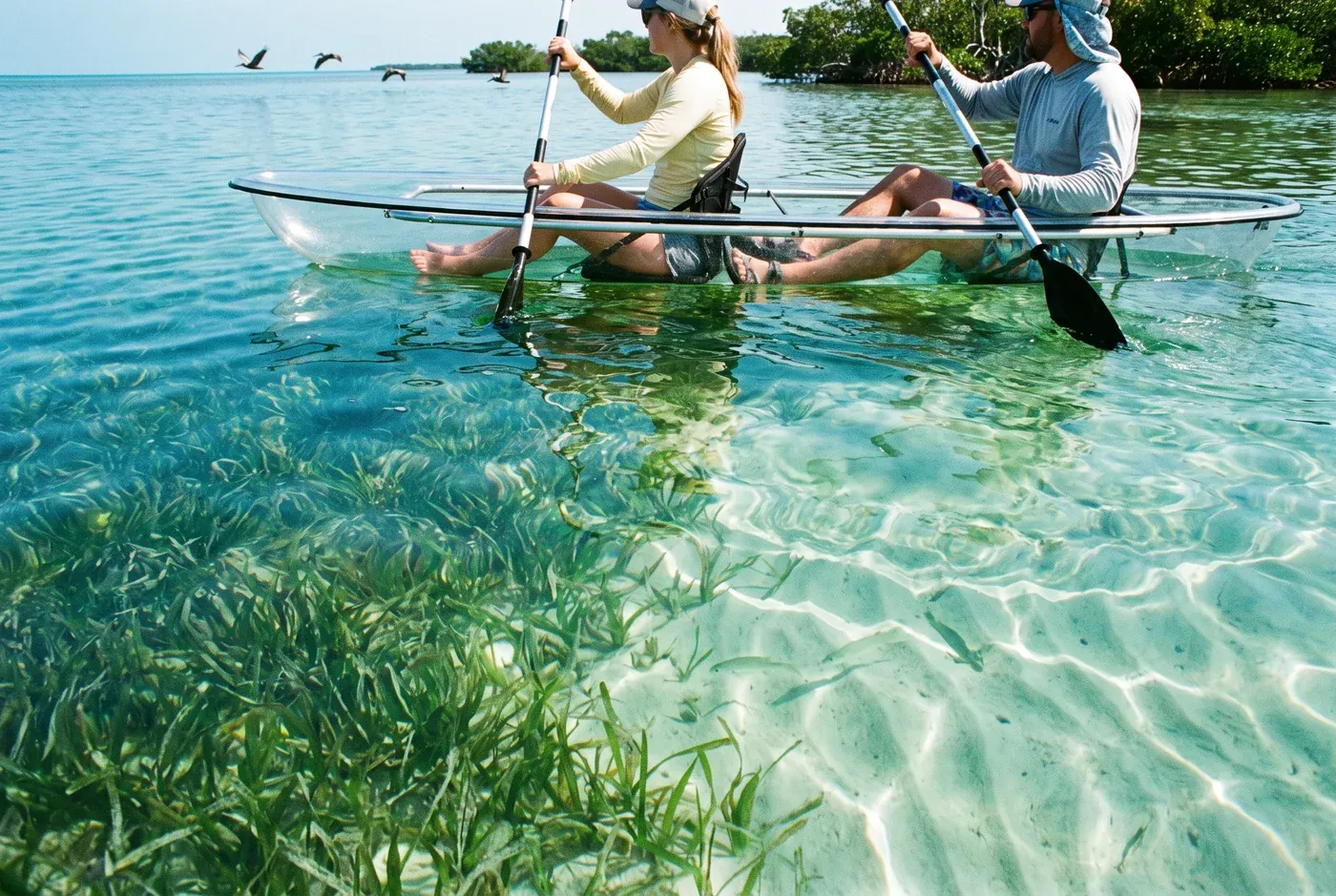
Our clear kayaks are $50 a day, one paddler each, with safety gear included. The transparent hull makes the riverbed and the grass below you part of the trip. Pick one up, take your time, and let the current do some of the work.